

Stock Market Foundations
What a share is, how exchanges work, and how an order becomes a trade.
1. What the stock market is
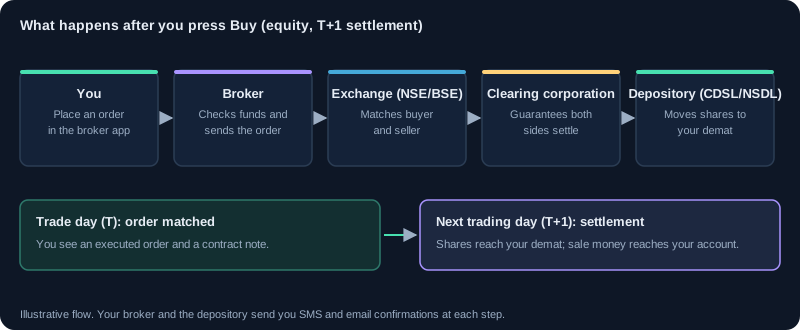
A stock market is a marketplace where companies sell small pieces of ownership, called shares, and where people then buy and sell those shares with each other. It does two jobs. It helps companies raise money to grow, and it lets owners sell when they need cash. Because owners can sell, people are willing to buy shares in the first place.
- Primary market: a company sells new shares for the first time, for example through an IPO (initial public offering). The company receives the money.
- Secondary market: investors trade shares among themselves on an exchange. This is where almost all daily trading happens. The money moves from one investor to another, not to the company.
- A listed company is one whose shares are traded on a recognised exchange, such as NSE or BSE.
2. What a share is and how you earn from it
Owning one share makes you a part-owner of that company, however small your stake. Your money can grow in two ways, and it can also shrink. Nothing is guaranteed.
- Capital gain: you sell for more than you paid. Example: you buy 10 shares at ₹500 (₹5,000) and sell at ₹550 (₹5,500). The gain is ₹500 before costs and tax.
- Dividend: a share of profit the company pays to shareholders, usually per share. Example: ₹10 per share on 10 shares gives ₹100. Dividends are decided by the company and are not guaranteed.
- Capital loss: if the price falls, your holding loses value. Example: you sell the same 10 shares at ₹420 and lose ₹800 before costs.
- Limited liability: as a shareholder you can lose the money you invested, but you are not responsible for the company's debts beyond that amount.
3. Who is who in the market
Several parties work together for a trade to happen and for your shares to be safe.
- You (the investor): decide what to buy and sell, and bear the gains and losses.
- Broker: a SEBI-registered firm that takes your orders and sends them to the exchange.
- Stock exchanges (NSE and BSE): run the trading system where buyers and sellers are matched.
- Clearing corporations: guarantee that trades settle, by taking the risk that one side does not pay or deliver.
- Depositories (NSDL and CDSL): hold your shares electronically in your demat account.
- SEBI (Securities and Exchange Board of India): the regulator that sets rules, licenses intermediaries and protects investors.
- Asset management companies (AMCs): run mutual funds, which pool money from many investors.
4. Open the accounts you need
To invest in shares you need three things: a bank account, a demat account and a trading account. Many brokers open the demat and trading accounts together.
- KYC (Know Your Customer): proof of identity and address, usually PAN and Aadhaar, a bank account, a photograph and a signature. It can often be done online.
- Demat account: holds your shares in electronic form. You do not receive paper share certificates for shares held this way.
- Trading account: lets you place buy and sell orders through your broker. Your money for trades sits here.
- Nomination: name a nominee so your holdings can pass to them safely if something happens to you.
- Choose a SEBI-registered broker. Check their registration on SEBI's website before you open an account, and be wary of anyone who promises returns.
5. Market timings and trading sessions
Indian equity markets trade on working days, and the timings below are typical. Check the exact times and the holiday list on the NSE or BSE website each year, because they can change.
- Pre-open session (around 9:00 to 9:08 for orders, then price discovery until 9:15): orders are collected and an opening price is set.
- Normal trading session (around 9:15 to 15:30): continuous buying and selling. This is when most trades happen.
- Closing session after 15:30: used to settle the closing price for certain orders. Check current timings on the exchange website.
- Exchange holidays: the market is closed on published holidays, so no trades happen on those days.
- Orders placed outside market hours are usually held until the next session. Some brokers offer after-market orders (AMO) that are sent when the market opens.
6. Order types, explained
An order is your instruction to the exchange. The type you choose controls how sure you are of the price and whether the trade will happen.
- Market order: buy or sell now at the best available price. The trade is very likely to happen, but the price can move before it fills.
- Limit order: you set the price. Example: buy only at ₹495 or lower. You control the price, but the order may never fill if the price does not reach your limit.
- Stop-loss (SL) order: a limit order that becomes active when the price reaches a trigger. Example: trigger ₹240 with limit ₹239 for a sell means: when the price falls to ₹240, try to sell at ₹239 or better.
- Stop-loss market (SL-M): becomes a market order at the trigger price. It is more likely to fill, but the price may be worse than the trigger.
- Validity: a Day order lasts for the session. An IOC (immediate or cancel) order fills right away or is cancelled.
7. Product types: delivery and intraday
Your broker will ask which product you want for each order. The choice must match your plan, because the rules and risks are different.
- Delivery (usually called CNC): you buy and hold the shares in your demat account for as long as you want. You pay the full price. This is how most long-term investors invest.
- Intraday (usually called MIS): you buy and sell within the same day. You must close the position by a cut-off time, and brokers may square it off automatically. It uses margin (borrowed money) and can cause large losses.
- Never use intraday or margin products without understanding them. Start with delivery trades while you learn.
8. Settlement: when shares and money actually move
A trade does not change ownership on the spot. Settlement is the process that moves the shares and the money. In India, equity trades settle on T+1, which means one trading day after the trade.
- Example: on Monday at 10:00 you buy 10 shares. The order is executed on Monday and you receive a contract note.
- On Tuesday (T+1), the shares are credited to your demat account and the money is debited from your trading account, if the settlement goes through.
- After you sell, the sale money is usually available to withdraw after settlement. Check your broker's rules on when it becomes available.
9. What trading costs you
Every trade has costs that come out of your return. Charges vary by broker and change over time, so read your broker's charge page and your contract note.
- Brokerage: the broker's fee for executing the trade.
- Exchange transaction charges and SEBI turnover fee: charged by the exchange and the regulator.
- Stamp duty: charged on the buying side.
- STT (Securities Transaction Tax): a government tax on the transaction, with rates that depend on the type of trade.
- GST: charged on brokerage and some other charges.
- Depository charges: charged when you sell shares from your demat account.
Illustration: you buy ₹5,000 of shares and sell at ₹5,500, with ₹60 of total costs. Your net gain is ₹440, not ₹500. Costs matter most for small or frequent trades.
10. How prices move
A share price changes when buyers and sellers disagree about its value at the current price. Understanding the basic mechanics helps you read the screen and avoid surprises.
- Order book: shows the current buy orders (bids) and sell orders (asks) at each price. The best bid is the highest buy price; the best ask is the lowest sell price.
- Spread: the gap between the best bid and the best ask. A narrow spread usually means a liquid stock.
- Volume: the number of shares traded in a period. Higher volume means more participation.
- News, company results, economic data and global markets all shift demand and supply, and so move prices.
- Circuit limits: an exchange sets a daily upper and lower price band for many stocks. If the price hits a band, trading in that stock may pause or be restricted. Limits can differ by stock.
11. Indices, market size and company categories
- NIFTY 50 (NSE) and SENSEX (BSE) are indices that track large companies. They show the overall direction of the market.
- Market capitalisation = share price × total number of shares. SEBI groups listed companies into large, mid and small caps by market-cap rank. Check SEBI's current definition.
- Large caps are usually more stable. Small caps can grow faster, but their prices can swing much more.
- An index is a benchmark. Compare your returns with it to judge how well you are doing.
12. Taxes on your gains (basics only)
Gains from shares are taxed. Tax rates and rules change with the Union Budget, so always check the current rules with a tax professional or the official income tax website before you file.
- Profits from frequent or intraday trading are usually treated as business income.
- Profits from shares held as investments are capital gains. The tax depends on how long you held the shares (short-term or long-term).
- Keep your contract notes, P&L statements and bank records. They are needed when you file your return.
13. Protect yourself from scams
Scams target new investors. The warning signs are often easy to spot once you know them.
- No one can guarantee returns from shares. Any promise of fixed high returns is a warning sign.
- Be careful with stock tips on WhatsApp or Telegram, and with groups that ask for money to 'join' a trading club.
- Check that anyone advising you or managing your money is SEBI-registered, using SEBI's list of registered intermediaries.
- Never share your OTP, PIN, or demat and trading login details with anyone.
- If you have a complaint, SEBI's SCORES portal is the official way to raise it.
14. Your first-steps checklist
- Set a goal and a time frame, for example saving for a house in seven years.
- Build an emergency fund of about 3 to 6 months of expenses before you invest for growth.
- Learn in this order: Stock Market Foundations, Investing, SIP and Mutual Funds, Reading Charts, Risk Management. Then move on to the rest.
- Start with a small amount that you can afford to lose.
- Keep a journal of every decision, including why you made it. Review it monthly, not daily.
Charts and visuals
Worked examples
Buying 10 shares
A stock trades at ₹500. Buying 10 shares costs 10 × ₹500 = ₹5,000 (plus brokerage and taxes). If the price rises to ₹550, the holding is worth ₹5,500, a gain of ₹500, or 10% before costs.
Limit order that never fills
The stock is at ₹500 and you place a limit buy at ₹495. If the price never drops to ₹495, your order stays open and you do not own the shares. A limit order protects the price but does not guarantee a trade.
Real-life scenarios
Placing an order before the opening bell
You place a market buy at 9:20 am, before the open. News overnight has moved the stock, so the price opens 4% higher than yesterday's close. Your order fills at the new price. A limit order would have capped what you pay.
Planning when cash becomes available
You sell shares on Monday. Under T+1 the sale settles on Tuesday. If you need the money on Monday, the cash is not yet yours to withdraw. Check your broker's rules on when sale proceeds become available.
Use cases
- Checking company announcements on NSE or BSE before you buy, since listed companies must disclose material news.
- Using NIFTY 50 as a benchmark: if your portfolio gained 6% while the index gained 9%, you trailed the market.
- Understanding why your shares sit in a demat account and how a sale moves them out.
Key takeaways
- A share is a fraction of ownership; your return depends on price and dividends.
- A market order gets filled quickly at an uncertain price; a limit order controls the price but may not fill.
- Know your settlement cycle (T+1) before you plan to use sale money.
- Always check brokerage and taxes, because they reduce the real return.
Key terms, explained
- Share (stock)
- A unit of ownership in a company. Holding shares makes you a part-owner.
- Equity
- Ownership in a company through shares. Also used for the value left for shareholders after debts.
- Index
- A measure that tracks a selected group of shares, such as NIFTY 50 or SENSEX.
- NIFTY 50
- An index of 50 large companies listed on the National Stock Exchange (NSE).
- SENSEX
- An index of 30 large companies listed on the Bombay Stock Exchange (BSE).
- NSE and BSE
- India's two main stock exchanges, where listed shares are bought and sold.
- SEBI
- The Securities and Exchange Board of India, the regulator that protects investors and oversees markets.
- Demat account
- An account that holds your shares in electronic form.
- Trading account
- The account used to place buy and sell orders through a broker.
- KYC
- Know Your Customer: identity and address verification required before you can invest.
- Broker
- A registered intermediary that executes your buy and sell orders on an exchange.
- Order
- An instruction to buy or sell a security at a given price or at the best available price.
- Market order
- An order to buy or sell immediately at the best available price. The final price may differ from the displayed one.
- Limit order
- An order to buy at or below, or sell at or above, a set price. It may not execute.
- Stop-loss order
- An order that becomes a market or limit order when price reaches a set level, to limit a loss. It is not guaranteed to fill at that level.
- Bid and ask
- Bid is the highest price a buyer offers; ask is the lowest price a seller accepts.
- Spread
- The gap between bid and ask. Narrow spreads usually mean a liquid stock.
- Liquidity
- How easily an asset can be bought or sold without moving its price much.
- Volume
- The number of shares traded in a period. High volume means more participation.
- Settlement (T+1)
- The process of transferring shares and money after a trade. In India, equity trades settle one trading day after the trade (T+1).
- Circuit limit
- A maximum daily upper or lower price move allowed for a stock. Trading may pause when it is hit.
- Market capitalisation (market cap)
- Share price multiplied by the number of shares outstanding. Companies are grouped as large, mid or small cap.
- Dividend
- A share of profit a company pays to its shareholders, usually per share.
- Brokerage
- The fee a broker charges for executing a trade.
- STT (Securities Transaction Tax)
- A tax charged by the government on securities transactions, varying by trade type.
- Intraday
- Trades opened and closed within the same trading session. Positions must be squared off before the market closes.
Questions learners ask
Can I start with a small amount like ₹500?
Yes, if you can buy at least one share. The share price is the minimum you need for a delivery purchase, plus costs. Start with an amount you can afford to lose.
Will I lose all my money if I invest in shares?
You can lose money, including all of a single holding in a worst case. Spreading money across several companies and sectors, and never investing money you need soon, reduces that risk. No one can guarantee returns.
Why are my shares not in my demat account on the day I bought them?
Equity trades settle on T+1, one trading day after the trade. The shares are credited on settlement day, not the trade day. Check your broker's settlement status if they are not there by then.
Educational content only, not investment advice. Markets carry risk, including loss of capital. Examples are simplified and may exclude charges, taxes and slippage.