

Valuation Basics: What Is a Share Worth?
P/E, P/B, EV/EBITDA, PEG and discounted cash flow explained, with their limits and how to combine them.
1. Price is not value
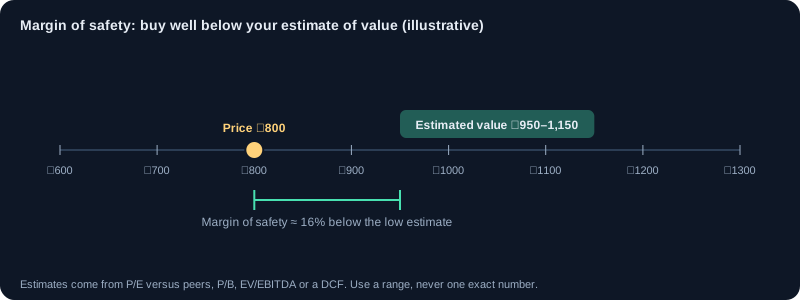
A share price is what the market pays today. Value is what the business is worth based on its future cash flows. Valuation tries to estimate the second and compare it with the first. The gap between the two is the margin of safety.
2. P/E: price to earnings
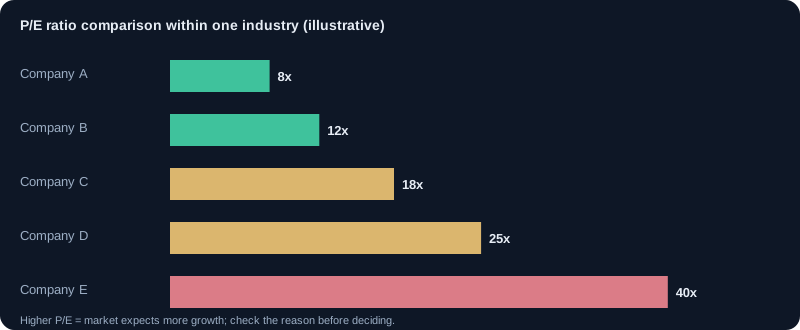
P/E = price ÷ earnings per share. It shows how many years of current earnings you pay for. Compare it with the company's own history and with peers in the same industry. A low P/E is not automatically cheap if earnings are falling.
Example: price ₹450, EPS ₹30, so P/E = 15. If peers average 20, the stock looks inexpensive, but check growth and risk first.
3. P/B: price to book
P/B = price ÷ book value per share. It is most useful for banks and asset-heavy businesses, where book value is meaningful. For asset-light businesses such as software, book value says little and P/B can mislead.
4. EV/EBITDA: a capital-structure-neutral view
Enterprise value (EV) = market capitalisation + debt − cash. EV/EBITDA compares the whole business value with operating earnings before interest, tax, depreciation and amortisation. It is useful for comparing companies with different debt levels.
5. PEG: growth-adjusted P/E
PEG = P/E ÷ expected earnings growth rate (in percent). A PEG around 1 is often read as fairly priced, below 1 as possibly cheap, above 2 as expensive. Growth forecasts are uncertain, so treat the result as a rough guide.
6. Discounted cash flow (DCF): the basic idea
DCF estimates the future free cash flows of a business and discounts them back to today, because money in the future is worth less. The result depends heavily on the growth rate and the discount rate. Small changes in assumptions change the answer a lot. Use it to test what you must believe to justify the price.
Example: free cash flow ₹100 crore growing 10% a year for five years, then 5%, discounted at 12%. The total present value gives an estimate of the business value. Change the growth to 8% and the value falls noticeably.
7. Combine methods and set a range
No single method is right. Use two or three: a P/E comparison with peers, an EV/EBITDA check, and a simple DCF. Overlapping results give more confidence. Decide the range of value, and buy only when the price is comfortably below the middle of that range.
8. Common valuation mistakes
- Using one ratio as the answer.
- Comparing companies from different industries with the same P/E.
- Using peak earnings as the base for a P/E.
- Forgetting to adjust for one-off items and debt.
- Building a precise DCF from guesses without testing sensitivity.
Charts and visuals
Key terms, explained
- P/E ratio
- Share price divided by earnings per share. It shows how much investors pay for each rupee of earnings.
- Book value
- Shareholders' equity divided by the number of shares: the accounting value per share.
- EV/EBITDA
- Enterprise value (market cap plus debt minus cash) divided by EBITDA. A valuation measure that is neutral to debt levels.
- PEG ratio
- P/E ratio divided by the expected earnings growth rate. A rough guide to whether a growth stock is fairly priced.
- Discounted cash flow (DCF)
- A valuation method that estimates future cash flows and discounts them to today's value.
- Margin of safety
- The gap between estimated value and price. Buying with a margin protects you if your estimate is too optimistic.
- Market capitalisation (market cap)
- Share price multiplied by the number of shares outstanding. Companies are grouped as large, mid or small cap.
Educational content only, not investment advice. Markets carry risk, including loss of capital. Examples are simplified and may exclude charges, taxes and slippage.