

Risk Management
Protect your capital with position sizing, stop losses, exposure limits and a drawdown plan.
1. Why risk management comes first
Risk management decides whether you survive long enough for your edge to work. Every trader has losing trades, and the question is not whether you will lose, but how much each loss costs and how many in a row you can absorb. Good risk management keeps losses small and survivable, so that your plan has time to produce results.
2. Drawdown: the arithmetic of losses
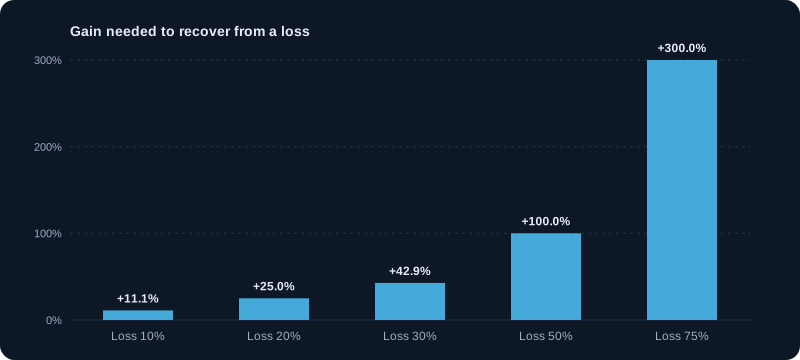
Losses hurt more than equal gains help, because the recovery percentage grows faster than the loss. A 10% loss needs 11.1% to recover. A 20% loss needs 25%. A 50% loss needs 100%. A 75% loss needs 300%. Protecting capital is therefore the first job of any trading plan.
- 10% loss → 11.1% gain needed
- 20% loss → 25% gain needed
- 30% loss → 42.9% gain needed
- 50% loss → 100% gain needed
- 75% loss → 300% gain needed
3. Risk per trade: the central rule
Risk a fixed small percentage of your capital on each trade, usually 0.5% to 2%. This makes every trade a small event. Ten losses in a row at 2% each reduce capital by about 18%. The same ten losses at 0.5% reduce it by about 5%. Smaller risk gives you time to learn and to recover mentally.
4. Position sizing: converting risk into shares
Position size equals the risk amount divided by the risk per share (the distance from entry to stop). This turns your risk rule into a number of shares.
Example: capital ₹5,00,000, risk 1% = ₹5,000. Stop distance ₹20 per share. Size = 5,000 ÷ 20 = 250 shares. At ₹400 per share, the position is ₹1,00,000, which is 20% of capital. The loss at the stop is still only ₹5,000.
5. Reward-to-risk and win rate together
A high win rate is not required if your winners are larger than your losers. A 1:2 reward-to-risk system needs to win only about one trade in three to break even before costs. A 1:1 system needs a win rate above 50%. Judge a system by its expectancy: (win rate × average win) − (loss rate × average loss).
Example: win rate 40%, average win 2R, average loss 1R. Expectancy = 0.4 × 2 − 0.6 × 1 = +0.2R per trade. Over 100 trades, that is +20R before costs.
6. Exposure: total risk, not just single-trade risk
Five trades of 1% each, all in banking stocks that move together, are close to a single 5% bet on the sector. Track total open risk across all positions, and limit the risk in any one sector or theme (for example, 6% of capital in total open risk, and no more than 3% in one sector).
- Total open risk: the sum of the risk on all open positions.
- Correlation: stocks in the same sector or index often fall together.
- Cash buffer: keeping part of capital uninvested gives room to act and reduces forced decisions.
7. Drawdown rules: what to do when it goes wrong
Set your rules before a bad period. A drawdown rule tells you what to do when losses pile up, so that emotion does not decide.
- Monthly loss limit: if the month's loss reaches a set level (for example 5% of capital), stop trading until the next month and review.
- Losing streak rule: after three losses in a row, cut position size by half until you have a winning trade.
- Account drawdown rule: at a 15% drawdown from the peak, stop, review the journal, and return with smaller size.
- Never add to a losing position to recover faster. This is how a small loss becomes a large one.
8. Stop-loss placement that matches risk
A stop-loss should be placed where your idea is wrong, not where you can afford the loss. If the logical stop is too far for your risk rule, the position is too big or the trade is not suitable. Skip the trade rather than widen the stop. Volatility-based stops (for example 2 times ATR) account for normal daily movement.
9. Leverage and margin: the multiplier of risk
Leverage multiplies both gains and losses. With 5 times margin, a 2% adverse move on the full position is a 10% loss on your cash. Margin calls can force you out at the worst price. If you use leverage, lower the risk per trade so that the loss at the stop is still your planned amount.
10. Psychology of risk
Most traders break risk rules after a loss, after a win, or when a trade is close to a target. Write the rules, put them where you can see them, and treat any rule break as a serious mistake to review. The rules are there to protect you from your own impulses.
11. A risk checklist before every trade
- What is the maximum loss in rupees, and is it within my per-trade limit?
- Where is the stop, and why is it there?
- What is the position size, and how did I calculate it?
- What is the total open risk, including this trade?
- Is there an event (results, news) before the planned exit?
- Is my decision based on the plan, or on how I feel right now?
Charts and visuals
Worked examples
Recovery from a drawdown
A 10% loss needs an 11.1% gain to recover (1 ÷ 0.9 − 1). A 20% loss needs 25%. A 50% loss needs 100%. The deeper the loss, the harder the climb back.
Position size from risk
Capital ₹5,00,000, risk 1% = ₹5,000. Stop distance ₹20 per share, so size = 5,000 ÷ 20 = 250 shares. At ₹400 per share the position is ₹1,00,000, which is 20% of capital. Small risk can still mean a large position.
Real-life scenarios
Losing streak
You lose 5 trades in a row at 1% risk each. Capital falls about 4.9%. Following your rule of cutting size after losses keeps the damage contained and gives you time to review.
Hidden sector concentration
You hold three IT stocks at 10% of capital each. That is 30% in one sector. A bad sector week hits all three together, so the real risk is larger than it looks.
Use cases
- Setting a maximum daily loss limit and stopping trading when it is reached.
- Sizing every swing trade from a fixed percentage of capital.
- Capping total exposure to any single sector or theme.
Key takeaways
- Protect capital first; avoiding large losses matters more than chasing large gains.
- Size positions from the stop distance and your risk limit.
- Track exposure across correlated positions.
- Have written rules for drawdowns before you need them.
Key terms, explained
- Drawdown
- The fall from a peak to a later low in your account or in a price, shown as a percentage.
- Position sizing
- Deciding how many shares to buy based on the maximum loss you accept and the distance to your stop.
- Risk-reward ratio
- The potential profit of a trade compared with its potential loss. A 1:2 ratio means ₹2 of reward for each ₹1 risked.
- Leverage
- Using borrowed money or margin to take a bigger position. It magnifies both gains and losses.
- Diversification
- Spreading money across different investments to reduce the damage from any one of them.
- Volatility
- How much and how quickly a price moves. Higher volatility means bigger swings in both directions.
Questions learners ask
What percentage of capital should I risk per trade?
Many traders use 0.5% to 2%. The right number depends on your capital, experience and how many losses in a row you can handle emotionally and financially.
How do I set a stop-loss?
Place it at a level where your trade idea is proven wrong, such as below support or a swing low, and size the position so that the loss at that stop equals your planned risk. ATR can help set the distance.
What is a good risk-reward ratio?
A ratio of 1:2 or better is commonly used, because the strategy can still be profitable with a win rate below 50%. The ratio alone does not make a trade good; the win rate and costs matter too.
Educational content only, not investment advice. Markets carry risk, including loss of capital. Examples are simplified and may exclude charges, taxes and slippage.