

Investing & Wealth Building
Set goals, understand your time horizon, diversify, and let compounding work over years.
1. Why invest at all?
Money kept in a savings account loses value when prices rise. If inflation is 6% a year, ₹1,00,000 kept idle is worth about ₹94,000 in today's purchasing power after one year. Investing aims to earn more than inflation over time, so your money keeps its buying power and grows. Investing is not the same as earning quickly; it is a plan that works over years.
- Inflation: the general rise in prices. It quietly reduces what your money can buy.
- Return: the gain or loss on an investment, usually shown as a yearly percentage.
- Risk: the chance that the actual outcome differs from what you expect, including losing money.
2. Start with goals and time horizon
Every investment decision depends on two questions: what is the money for, and when will you need it? The answers decide how much risk you can take. A goal in 2 years needs safer assets, because a market fall right before you need the money can force a loss. A goal in 15 years can hold more shares, because there is time to recover from falls.
- Short term (under 3 years): emergency money, a vehicle down-payment. Prefer low-risk options such as fixed deposits, liquid or debt funds.
- Medium term (3 to 7 years): a house down-payment, a child's school fees. A balanced mix of debt and equity is common.
- Long term (7 years or more): retirement, a child's higher education. Equity has historically given higher returns over long periods, with larger swings along the way.
3. Build the base first: emergency fund and insurance
Before you invest for growth, protect yourself. An emergency fund stops you from selling investments at a bad time to pay for a surprise expense. Health and term insurance protect your family and your plan from a single event that could undo years of saving.
- Emergency fund: 3 to 6 months of essential expenses in a savings account, liquid fund or fixed deposit. Keep it separate from investments.
- Health insurance: covers medical costs so that you do not need to sell investments for hospital bills.
- Term insurance: if others depend on your income, a term plan pays a lump sum to them if you die. It is pure protection, not an investment.
- Clear high-interest debt, such as credit card balances, before investing, because the interest you pay is usually higher than what you expect to earn.
4. Compounding: why time matters most
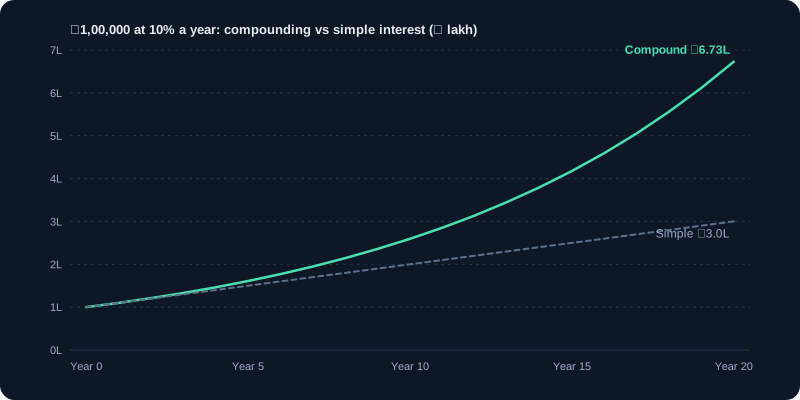
Compounding means your returns earn their own returns. The effect looks small for the first few years and then grows quickly. The longer the money stays invested, the more of the growth comes from earnings rather than from the amount you put in.
Example: ₹1,00,000 at 10% a year grows to about ₹2.59 lakh in 10 years and about ₹6.73 lakh in 20 years, before tax, fees and inflation. The extra ten years add more than ₹4 lakh even though you add nothing new. Returns are not guaranteed; this is an illustration.
5. Asset classes: what each one does
An asset class is a group of investments that behave similarly. Each one has a different role in a portfolio.
- Equity (shares): ownership in companies. Highest long-term growth potential, highest short-term swings.
- Debt (bonds, fixed deposits, debt funds): lending money for interest. Lower swings, lower long-term growth, but the interest is predictable (subject to credit risk).
- Gold: often used as a hedge during uncertainty. Its price can stay flat for long periods.
- Cash and liquid funds: for emergencies and short-term needs. Very low growth, very high availability.
- Real estate: a large, illiquid asset. It needs substantial capital and carries costs and time to sell.
6. Diversification and asset allocation
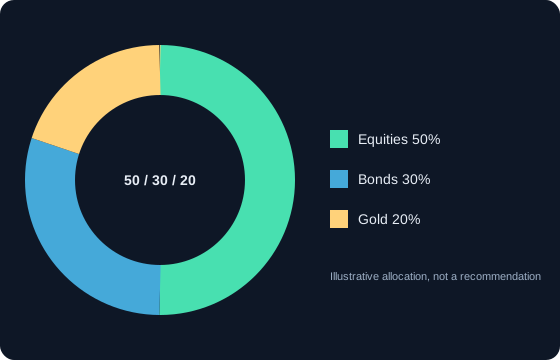
Diversification spreads money so that one bad investment does not sink your plan. Asset allocation is how you split money between asset classes. It is the biggest single decision in most portfolios, more important than picking individual stocks.
Example: a 60% equity and 40% debt split reduces the impact of an equity fall. If equities fall 20% and debt rises 3%, the portfolio falls 0.6 × 20 − 0.4 × 3 = 10.8%, instead of 20%. The numbers are illustrative.
7. Rebalancing: keeping the plan on track
Over time, the asset that grew most becomes a larger share of your portfolio, which raises your risk without you deciding it. Rebalancing means selling a little of what has grown and buying what has fallen to return to your target split. Doing this once or twice a year is usually enough.
- Set the target split first, for example 60% equity and 40% debt.
- Check once or twice a year, or when the split drifts by about 5 percentage points.
- Rebalancing can have tax consequences. Check the rules in the tax module before selling.
8. How to invest, step by step
- Write the goal, amount and time frame in one line.
- Build the emergency fund and get basic insurance.
- Choose the asset mix that fits your time frame.
- Pick simple, low-cost, diversified funds or stocks you understand. Read the factsheet or annual report first.
- Invest regularly through a SIP or a fixed monthly transfer, so the habit runs without effort.
- Review once or twice a year. Do not change the plan because of a week's news.
9. Common investing mistakes
- Investing money you need in the next year or two.
- Chasing last year's best performer without asking why it did well.
- Stopping SIPs during a fall, which means you stop buying cheap units.
- Putting everything in one stock, sector or your own employer's shares.
- Paying high fees for products that you do not need or understand.
- Trusting guaranteed-return promises. No legitimate product promises high fixed returns from shares.
10. Measuring your progress
Judge your plan against your goal, not against a friend's returns or a single month's news. Track the money you invested, the current value, and the goal progress. Compare your portfolio with a benchmark that matches its mix, such as an index for the equity part, over several years.
Charts and visuals
Worked examples
How much to invest today
Your goal is ₹10 lakh in 5 years, and you expect 10% a year. Today's amount needed is 10,00,000 ÷ 1.1⁵ = 10,00,000 ÷ 1.6105 ≈ ₹6,20,921. Compounding does most of the work.
One stock vs a mixed portfolio
Portfolio A is 100% in one stock that falls 40%: total loss 40%. Portfolio B is 50% in an index fund (−20%), 30% in bonds (+2%), and 20% in gold (+5%). Result: 0.5×(−20) + 0.3×2 + 0.2×5 = −8.4%. Diversification limits the damage.
Real-life scenarios
Market falls 30% after you start investing
If your goal is 10 years away, continuing to invest buys more units at lower prices, which can help long-term returns. If you needed this money next year, the same fall would force a sale at a loss. Your time horizon decides how to react.
A friend promises 25% guaranteed returns
Equity returns are never guaranteed. A promise of fixed high returns is a common warning sign of fraud. Check whether the entity is SEBI-registered before sending money.
Use cases
- Retirement planning: start early and let a long horizon absorb market swings.
- Child's education fund: move money gradually to safer assets as the target date approaches.
- Emergency fund: keep 3 to 6 months of expenses in cash or liquid funds, separate from investments.
Key takeaways
- Define the goal and time horizon before choosing investments.
- Compounding rewards time in the market more than the size of any single contribution.
- Spread money across assets and sectors to reduce the impact of one bad investment.
- Rebalance periodically and be wary of guaranteed-return promises.
Key terms, explained
- Compounding
- Returns that earn their own returns over time, so growth accelerates.
- Diversification
- Spreading money across different investments to reduce the damage from any one of them.
- Asset allocation
- How you split money among asset classes such as equity, debt, gold and cash, based on goals and risk.
- Emergency fund
- Cash or very safe, liquid savings to cover 3 to 6 months of expenses. Keep it separate from investments.
- Inflation
- The general rise in prices over time, which reduces what your money can buy.
- Volatility
- How much and how quickly a price moves. Higher volatility means bigger swings in both directions.
Questions learners ask
When is the right time to start investing?
As soon as you have an emergency fund and a clear goal. Time in the market usually matters more than trying to pick the perfect entry point.
Should I invest a lump sum or in monthly amounts?
Both can work. Monthly investing reduces the risk of investing everything just before a fall. A lump sum has more time to grow if markets rise steadily. Choose the method you can stick with.
How many stocks do I need to be diversified?
There is no fixed number. Diversification comes from spreading across companies, sectors and asset types. Owning many stocks in the same sector is not very diversified.
Educational content only, not investment advice. Markets carry risk, including loss of capital. Examples are simplified and may exclude charges, taxes and slippage.