

Trading Psychology
Recognise biases such as fear, greed and overtrading, and build a disciplined process.
1. Why psychology decides results
Most trading plans fail not because the method is wrong, but because the trader does not follow it. Fear makes you exit winners early and hold losers. Greed makes you add size after a win. Frustration makes you chase a loss. Knowing these patterns, and building habits against them, is a skill that matters as much as analysis.
2. Common biases with examples
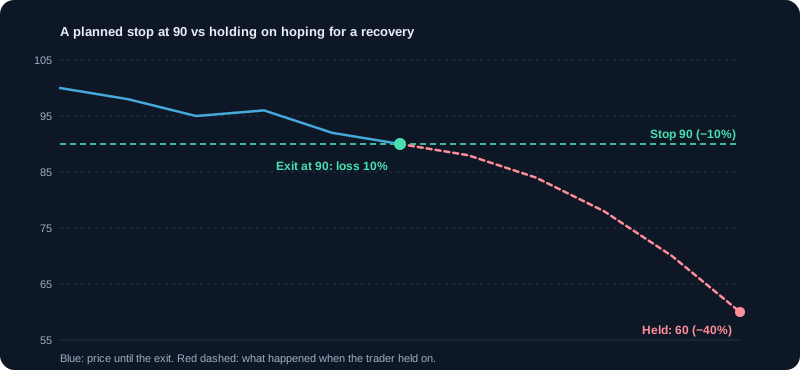
- Loss aversion: a loss feels roughly twice as painful as an equal gain feels good. Example: you hold a losing stock at ₹80 (bought at ₹100) instead of selling at a planned stop at ₹90, and it falls to ₹60.
- Overconfidence: after a few wins you believe you have skill, and you increase size or ignore your rules.
- Recency bias: you assume the latest trend will continue, and you forget longer history.
- Confirmation bias: you read only the news that supports your position.
- FOMO (fear of missing out): you chase a move after it has already run, buying near the top.
- Anchoring: you fix on a price, such as your purchase price, and judge decisions by it rather than by current information.
3. Process over outcome
A good decision can lose money, and a bad decision can make money in a single trade. Over many trades, the process determines the result. Judge each trade by whether you followed the plan and whether the plan was sound, not by whether it won. Otherwise you will change good rules after a bad run of luck, and keep bad habits after a lucky win.
4. Writing a trading plan
A plan answers the questions you will otherwise answer emotionally in the moment.
- Setups: the exact conditions for an entry.
- Risk: the maximum loss per trade and per day, and per week.
- Position size: how it is calculated.
- Exits: stop-loss rules and profit-taking rules.
- Trade limits: maximum trades per day and when to stop.
- Review: how often you review results, and what you will change only if the data shows a need.
5. Overtrading: the silent cost
Overtrading means trading more than your plan calls for, usually out of boredom, a desire to recover losses, or excitement. It raises costs, lowers the quality of decisions and increases stress. Set a maximum number of trades per day and a maximum loss per day. When you hit either, stop.
Example: 20 trades a day at ₹100 charges each costs ₹2,000 a day, or about ₹40,000 over 20 trading days, before any trading loss.
6. Revenge trading: the most damaging pattern
After a loss, many traders feel an urge to win the money back immediately. They increase size, take unplanned trades, or ignore their stops. This turns one loss into several. The cure is a rule set in advance: after two losses, or a set daily loss, the day is over. Step away from the screen, and review later.
- Pause for at least 15 minutes after a loss before taking another trade.
- Write down the trade and the emotion you felt. It is information, not a reason to act.
- Stop for the day when your rule says to.
7. Fear and hesitation
Fear shows up as exiting too early, not taking a valid setup after a string of losses, or moving a stop to avoid taking a loss. The fix is smaller size. When each trade risks an amount you can accept, fear has less power. If you cannot take a planned trade because you are afraid, reduce the size until you can.
8. Building routines
- Before the session: review the plan, the levels, the news and your maximum risk for the day.
- During the session: follow the checklist before each trade, and do not trade outside your setups.
- After the session: record each trade, the reason, the emotion and whether the rules were followed.
- Weekly: review patterns in the journal. Look for repeated mistakes, not single results.
- Rest: take breaks and avoid trading when tired, ill or upset.
9. The journal as a mirror
A journal shows what your memory hides. Record the setup, the reason, the size, the result in rupees and in R, and whether the plan was followed. After 30 to 50 trades, look for patterns: do you lose more on Mondays, after losses, or on trades you enter late? The data will often show a fixable habit more clearly than any book.
10. When to stop trading altogether
Stop and take a longer break if you break your rules repeatedly, if losses are affecting sleep or relationships, if you are trading money you cannot afford to lose, or if you feel the need to win back losses urgently. A stop is not failure; it protects capital and your health. Return only after reviewing what went wrong and reducing size.
11. Building discipline over time
Discipline is built by small repeated actions: following the stop, taking the planned size, keeping the journal and leaving the screen when the day is done. Measure discipline by rule-following, not by profit. A trader who follows the plan for 100 trades has learned more than one who wins three trades by luck.
12. Psychology checklist before each trade
- Is this trade in my plan, and does it meet every entry condition?
- What is my maximum loss, and am I comfortable with it?
- Am I trading to recover a loss, to escape boredom, or because I feel confident?
- Have I already reached my daily loss or trade limit?
- Would I take this trade if I had just had a great day?
Charts and visuals
Worked examples
Loss aversion in practice
You buy at ₹100 with a planned stop at ₹90. The stock falls to ₹90 but you hold, hoping it recovers. It falls to ₹60, a 40% loss instead of the planned 10%. The plan was right; the emotion broke it.
Cost of overtrading
You place 20 trades a day, each costing ₹100 in charges. That is ₹2,000 a day, or about ₹40,000 over 20 trading days, before any trading losses.
Real-life scenarios
Revenge trade
After three losses you double your size to recover quickly. The fourth trade fails and the day ends with a much bigger loss. A written rule to stop after three losses prevents this.
Big win, bigger risk
You make 8% in a month and start taking positions twice the usual size. One bad week erases the gains. Overconfidence after success is as dangerous as fear after failure.
Use cases
- Keeping a trade journal that records the reason for each trade and whether the rules were followed.
- Using a pre-trade checklist: setup, risk, stop, target, and why now.
- Running a weekly review to spot repeated mistakes such as early exits or late stops.
Key takeaways
- Judge decisions by process, not by one outcome.
- Write rules before the session and follow them during it.
- Recognise biases: loss aversion, overconfidence, recency and FOMO.
- Rest after large losses and avoid trading while emotional.
Key terms, explained
- Drawdown
- The fall from a peak to a later low in your account or in a price, shown as a percentage.
- Risk-reward ratio
- The potential profit of a trade compared with its potential loss. A 1:2 ratio means ₹2 of reward for each ₹1 risked.
- Position sizing
- Deciding how many shares to buy based on the maximum loss you accept and the distance to your stop.
- Diversification
- Spreading money across different investments to reduce the damage from any one of them.
Questions learners ask
How do I stop revenge trading after a loss?
Write a rule before the session, such as stopping after two losses or after a set daily loss. Step away from the screen after a loss and review the trade later, not immediately.
How do I know if I am overtrading?
If you take trades that are not in your plan, trade more after losses, or your costs are a large part of your profit, you are probably overtrading. Set a maximum number of trades per day.
Should I keep a trading journal?
Yes. Record the reason, the setup, the size, the result and whether you followed the plan. Patterns in your mistakes become visible only when you write them down.
Educational content only, not investment advice. Markets carry risk, including loss of capital. Examples are simplified and may exclude charges, taxes and slippage.