

Corporate Actions: Dividends, Bonus, Splits, Rights and Buybacks
What companies do with shares and cash, how each action changes the price and your holding, and how to avoid confusion on the ex-date.
1. What corporate actions are
A corporate action is an event started by the company that affects its shares or shareholders. Some change the number of shares, some pay cash, and some change the company's structure. Exchanges publish the dates, and the price adjusts on the effective day.
2. Dividends: the key dates
- Declaration: the board announces the dividend amount per share.
- Record date: shareholders on this date receive the dividend.
- Ex-date: the first day the shares trade without the right to the dividend. The price usually drops by about the dividend amount on this day.
- Payment date: when the cash is credited.
Example: a ₹10 dividend with the stock at ₹450. On the ex-date the price may open near ₹440. The fall is an adjustment, not a loss in value for a holder who received the dividend.
3. Bonus issue
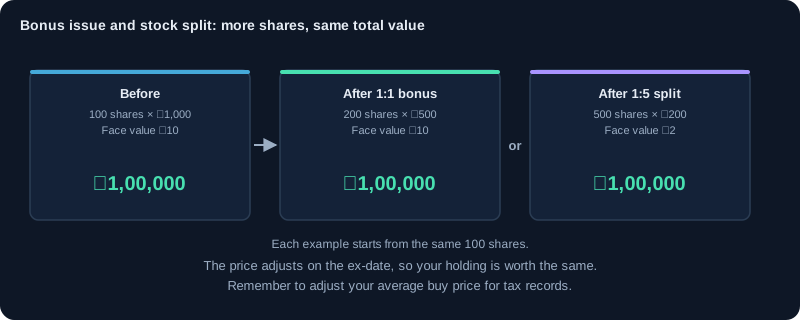
A bonus issue gives existing shareholders free additional shares from company reserves, in a fixed ratio. A 1:1 bonus gives one extra share for each share held. The price per share halves, but the total value of the holding is the same.
Example: 100 shares at ₹400 (₹40,000). After a 1:1 bonus: 200 shares at ₹200 (₹40,000). The value is unchanged.
4. Stock split
A split divides each share into more shares, reducing the price per share. A 1:10 split makes each share into ten. It improves trading accessibility but does not change the company's value. Check that old prices in charts are adjusted.
5. Rights issue
A rights issue lets existing shareholders buy new shares, usually at a discount, in proportion to their holding. Shareholders who do not take up the rights are diluted. Check the issue price, the ratio and whether the money is used to reduce debt or fund growth.
6. Buyback
A buyback is the company buying its own shares from the market or through a tender offer. It reduces the share count, which can raise EPS, and it signals management may think the shares are cheap. Check whether the company has enough cash, and whether the buyback is funded by borrowing.
7. Merger, demerger and delisting
Mergers combine companies, demergers split a business into separate listed companies, and delisting removes shares from the exchange. Each changes the shares you hold. Read the scheme document and decide what you will do with the new holdings or the exit price.
8. Practical rules
- Check the ex-date before buying for a dividend. Buying just before ex-date gives the right to the dividend; buying on or after does not.
- Adjust your cost price after a bonus or split.
- Read the rights issue terms and decide early, because the deadline is short.
- Keep records of all corporate actions for tax purposes.
9. Dates under T+1 settlement
Indian equities settle on T+1, so the ex-date and the record date now fall on the same day. To be entitled to a dividend, bonus or split, you must hold the shares at the end of the record date, which means buying no later than the trading day before the ex-date. Shares bought on the ex-date do not carry the benefit.
Example: the record date (and ex-date) is a Thursday. Buy on Wednesday or earlier to receive the dividend; your purchase settles on Thursday, so you are a holder at the end of the record date. Shares bought on Thursday settle on Friday, too late. Selling on Thursday still keeps your entitlement.
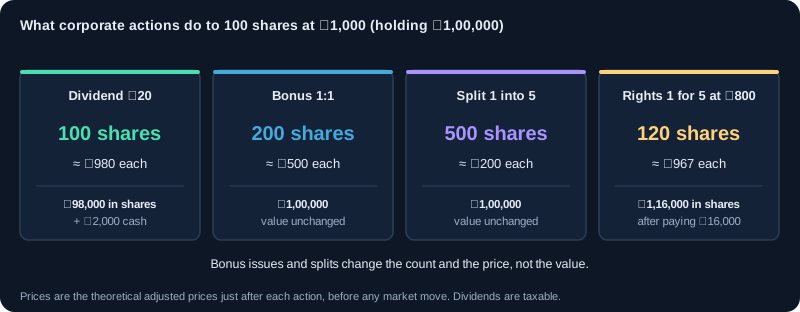
10. Before and after: what each action does to 100 shares
You hold 100 shares at ₹1,000 (holding value ₹1,00,000). Approximate prices just after each action, before any market move:
| Action | Shares after | Price after | Your position |
|---|---|---|---|
| Dividend of ₹20 per share | 100 | ≈ ₹980 | ₹98,000 in shares + ₹2,000 cash (taxable) |
| Bonus 1:1 (one free share for each held) | 200 | ≈ ₹500 | ₹1,00,000, no change |
| Split from ₹10 to ₹2 face value (1 into 5) | 500 | ≈ ₹200 | ₹1,00,000, no change |
| Rights 1 for 5 at ₹800, subscribed | 120 | ≈ ₹967 | ₹1,16,000 after paying ₹16,000 |
| Buyback at ₹1,200, 10 shares accepted | 90 | market price | ₹12,000 cash + 90 shares |
The rights price comes from the theoretical ex-rights price: (100 × ₹1,000 + 20 × ₹800) ÷ 120 ≈ ₹967. If you do not subscribe and do not sell your rights entitlements, your holding is diluted and you lose that value.
11. How each action is taxed in India
- Dividends: taxed in your hands at your income tax slab. The company deducts TDS of 10% if your dividends from it exceed ₹10,000 in a financial year (the threshold was ₹5,000 until 2024–25).
- Buybacks (from 1 October 2024): the whole amount you receive is taxed as dividend income at your slab. The cost of the shares bought back becomes a capital loss that you can set off against capital gains.
- Bonus shares: their cost is zero and their holding period starts on the allotment date. The cost of your original shares does not change.
- Splits: your original cost is divided across the new shares, and the holding period continues from the original purchase date.
- Keep the company's announcements and your contract notes: you will need them to work out gains correctly.
Tax rules change with each Budget. Check the current rules or ask a tax adviser before acting on a corporate action for tax reasons.
12. Rights issues and rights entitlements
- Rights entitlements (REs) are credited to your demat account before the issue opens.
- You can apply through your broker or bank (ASBA), buy additional REs, or sell your REs on the exchange during the trading period.
- If you do nothing, the REs lapse and you lose their value, while your percentage holding falls.
- Compare the rights price with the market price and ask why the company needs the money: growth, or repaying debt?
13. Mergers, demergers and derivatives adjustments
- Merger: you receive shares of the merged company in a set swap ratio, for example 3 shares of B for every 5 of A.
- Demerger: you keep the parent's shares and receive shares of the new company. The company announces how to split your original cost between them.
- Futures and options: the exchanges adjust open contracts for bonus issues, splits and rights, and for unusually large dividends, by changing the strike prices and lot sizes so the position's value is unchanged.
- Charts: data providers adjust price history for splits and bonuses; compare adjusted and unadjusted charts before drawing conclusions.
Charts and visuals
Worked examples
Dividend yield
A share at ₹500 pays dividends of ₹15 a year, a dividend yield of 3%. At a 30% tax slab you keep about ₹10.50 after tax, a post-tax yield of 2.1%.
Average cost after a bonus
You bought 50 shares at ₹800 (₹40,000). After a 1:1 bonus you hold 100 shares. The 50 original shares keep their ₹800 cost; the 50 bonus shares have zero cost with a holding period from allotment. Your broker's average may show ₹400; for tax, the split matters.
Real-life scenarios
The ex-date 'crash'
A stock opens 9% lower and new investors panic. It went ex-dividend for a special dividend of ₹90 on a ₹1,000 share. Holders received the cash; the business did not lose value. Price charts and P&L screens without adjustments can make this look like a loss.
Forgotten rights entitlements
An investor ignores a rights issue at a 25% discount. The REs lapse, the share price adjusts towards the ex-rights price, and the holding's value falls by about 4% overnight. Selling the REs would have recovered most of that value.
Use cases
- Timing a purchase so you are eligible for a dividend, or deciding it is not worth it after tax.
- Recalculating your cost and holding period after a bonus or split for capital gains tax.
- Deciding whether to subscribe to, sell or ignore a rights issue.
- Reading adjusted charts correctly around splits, bonuses and special dividends.
Key takeaways
- Bonus issues and splits change the share count and price, not the value of your holding.
- Under T+1, the ex-date and record date are the same day: buy at least one trading day before.
- Dividends and buyback proceeds are taxed at your slab; plan with post-tax numbers.
- Act on rights entitlements: subscribe or sell them, or lose value.
- Derivatives and charts are adjusted for corporate actions; know which version you are looking at.
Key terms, explained
- Dividend
- A share of profit a company pays to its shareholders, usually per share.
- Bonus issue
- Free additional shares given to existing shareholders from company reserves. The total value stays the same.
- Stock split
- Dividing existing shares into more shares. The price per share falls proportionally; the total value stays the same.
- Rights issue
- An offer to existing shareholders to buy new shares, usually at a discount, in proportion to their holding.
- Buyback
- When a company buys back its own shares from the market or through a tender offer, reducing the share count.
- Ex-date
- The first day a share trades without the right to an upcoming dividend or corporate action. The price usually adjusts on this day.
- Record date
- The date on which shareholders must be on the register to receive a dividend or benefit.
Questions learners ask
Is a bonus issue free money?
No. Your number of shares rises, but the price falls in the same proportion, so the value of your holding is unchanged. It can improve liquidity and signals confidence, but it adds no value by itself.
Should I buy a stock just before the dividend?
Usually it makes little difference: the price falls by about the dividend on the ex-date, and the dividend is taxed at your slab. Buy because you want to own the business, not for the dividend date.
Why did my holding show a loss after a split?
Some apps update the share count and price at different times. Check that the number of shares has multiplied; the value should be the same once both are updated.
Do I have to take part in a buyback?
No, it is optional. Compare the buyback price with the market price, the acceptance ratio, and the tax: since October 2024 the full buyback amount is taxed as dividend in your hands.
Educational content only, not investment advice. Markets carry risk, including loss of capital. Examples are simplified and may exclude charges, taxes and slippage.