

How to Read an Annual Report
The parts of a company's annual report, what each section tells you, and the warning signs to look for.
1. What the annual report is
The annual report is a company's full yearly document, prepared for shareholders and filed with the exchanges. It combines the financial statements, the directors' report, management's discussion, governance information and notices for the annual general meeting (AGM).
2. Read in this order
- Chairman's and CEO's letters: the story management wants you to hear. Useful for strategy, not proof.
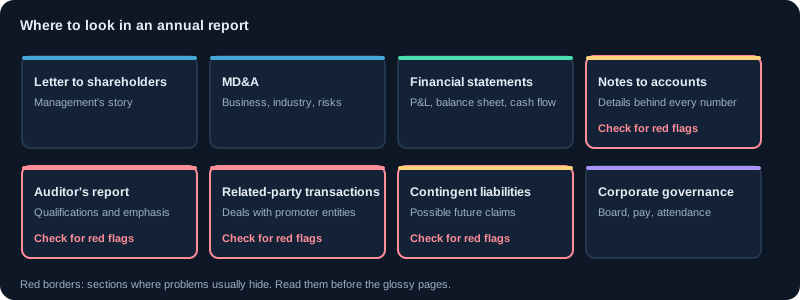
- Management Discussion and Analysis (MD&A): industry outlook, business performance, risks and opportunities. Often the most useful section.
- Directors' report: dividend recommendation, important events, related-party transactions summary.
- Auditor's report: the opinion on the financial statements. An unmodified opinion is normal; qualifications or emphasis of matter paragraphs need reading.
- Financial statements and notes: the detail behind every number.
- Corporate governance report: board composition, committees, remuneration and shareholder complaints.
3. The auditor's report
The auditor states whether the statements give a true and fair view. Watch for: a qualified opinion (an exception), an emphasis of matter (an important point the auditor wants you to notice), and key audit matters that show where the risks were judged to be highest. Changes of auditor should be checked in the reasons given.
4. The notes to accounts
The notes explain accounting policies, borrowings, contingent liabilities (possible future obligations), related-party transactions, segment results and employee benefits. Many important facts appear only in the notes. Reading them is what separates careful analysis from skimming.
5. Related-party transactions and governance
Transactions with companies owned by promoters or directors can be fair, or can move money out of the company. Check the size, the terms and whether they are recurring. Look at board independence, audit committee activity and any regulatory penalties listed.
6. Management commentary on risks
Companies must list risk factors. Read them for specifics: customer concentration, regulation, currency exposure, litigation. Vague lists that do not change year to year are less useful than detailed risks with what management is doing about them.
7. Compare two years side by side
Read the same sections across two annual reports. Look for changes in accounting policies, new large liabilities, changes in the auditor, and shifts in the segment mix. A change in wording can be as important as a change in numbers.
8. A reading checklist
- Read the MD&A before the letters.
- Check the auditor's opinion type and any emphasis of matter.
- Read the notes on borrowings, contingent liabilities and related parties.
- Compare risk factors with last year's report.
- Check dividend history and the payout relative to cash flow.
9. When it arrives and where to get it
Companies with a March year end must hold their annual general meeting (AGM) within six months, so by 30 September. The annual report is sent to shareholders at least 21 days before the AGM and filed with the exchanges, so it is usually out between July and early September. Download it from the NSE or BSE company page or the company's investor relations page; past years are there too.
10. Audit opinions, key audit matters and CARO
The auditor's report is the most important two or three pages in the document. Learn its vocabulary.
- Unmodified (clean) opinion: the accounts give a true and fair view. This is what you want to see.
- Qualified opinion: true and fair 'except for' a specific issue. Read the issue carefully.
- Adverse opinion or disclaimer of opinion: the accounts are materially wrong, or the auditor could not get enough evidence. Serious red flags.
- Emphasis of matter: a clean opinion that still points to an important issue, such as a large legal case or doubts about the company continuing as a going concern.
- Key audit matters (KAM): for listed companies, the areas the auditor found most significant, such as revenue recognition or valuation of goodwill.
- CARO report: an annexure in which the auditor reports on specific items such as loans to related parties, delays in paying statutory dues and frauds noticed.
A mid-term auditor resignation, a change of auditor without a clear reason, or a qualification that repeats year after year should make you step back.
11. Governance, pay and sustainability disclosures
- Corporate governance report: board composition, the share of independent directors, meeting attendance and the committees.
- Directors' report: dividend, transfers to reserves, subsidiaries, and related-party contracts.
- Managerial remuneration: listed companies disclose each director's pay as a ratio to the median employee's pay. Compare pay growth with profit growth.
- Business Responsibility and Sustainability Report (BRSR): required for the largest listed companies; covers environmental, social and governance data.
- Shareholding and promoter details, including any pledged shares, appear in the report too.
12. A 60-minute reading plan
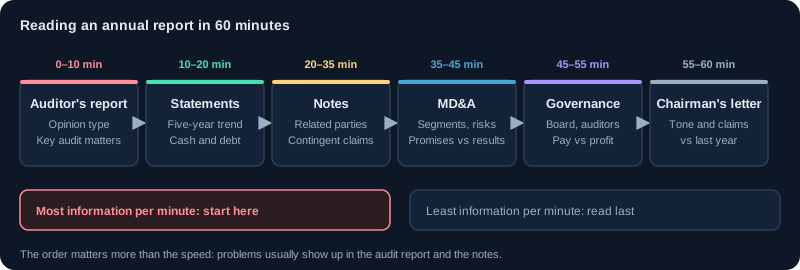
A full report can run to 300 pages. This order puts the most informative pages first.
| Minutes | Section | What to look for |
|---|---|---|
| 0–10 | Independent auditor's report | Type of opinion, key audit matters, emphasis of matter, CARO remarks |
| 10–20 | Financial statements and five-year summary | Trend of sales, margins, profit, operating cash flow and debt |
| 20–35 | Notes to accounts | Related-party transactions, contingent liabilities, borrowings, changes in accounting policies |
| 35–45 | Management discussion and analysis | Segment performance, capacity, risks, and last year's promises against results |
| 45–55 | Corporate governance and directors' report | Board independence, auditor changes, remuneration |
| 55–60 | Chairman's letter | Tone and claims; compare with last year's letter |
13. Warning signs checklist
- Auditor resigns or is changed mid-term, or the audit opinion is qualified.
- Frequent changes in accounting policies or in the financial year end.
- Large or growing loans, advances or guarantees to promoter-group companies.
- Contingent liabilities (disputed taxes, guarantees, legal claims) that are large compared with equity.
- Profit growing while operating cash flow stays weak for several years.
- Remuneration rising much faster than profit, or many related-party payments for vague services.
- Promises in the chairman's letter that are repeated year after year without results.
Charts and visuals
Worked examples
Contingent liabilities against equity
A company with equity of ₹2,000 crore discloses contingent liabilities of ₹900 crore, mostly disputed tax demands. If even a third of these turn into actual payments, about ₹300 crore (15% of equity) would be lost. Size the risk against the company's net worth.
Pay against profit
Over three years, net profit rose 10% while the managing director's pay rose 80% and the ratio to median employee pay went from 120 to 210 times. The numbers come straight from the remuneration disclosure and say something about governance.
Real-life scenarios
The note that mattered
A company's profit and sales look steady. In the related-party note, loans to a promoter-owned company grew from ₹50 crore to ₹400 crore in two years, with no interest received. The front pages never mention it. A year later the loan is written off.
Comparing two years of promises
Last year's report promised a new plant 'by next year'. This year's report says it is delayed to the following year, with costs up 30%. Reading two reports side by side shows management's track record better than either alone.
Use cases
- Checking the auditor's opinion and key audit matters before investing in a company.
- Finding related-party transactions and loans to promoter-group companies.
- Measuring contingent liabilities against equity.
- Judging management's credibility by comparing past promises with results.
Key takeaways
- Read the auditor's report and the notes first; the glossy pages come last.
- A clean opinion is the minimum; qualifications, disclaimers and auditor resignations are red flags.
- Related-party transactions and contingent liabilities hide in the notes.
- Governance shows in board independence, pay disclosures and auditor changes.
- Compare this year's report with last year's to test management's promises.
Key terms, explained
- Annual report
- A yearly document from a company with financial statements, management discussion and risks.
- Auditor's report
- An independent opinion on whether the financial statements give a true and fair view.
- Related-party transactions
- Dealings between a company and its promoters, directors or companies they control. They must be disclosed.
- Contingent liabilities
- Possible obligations that depend on a future event, such as a lawsuit. Disclosed in the notes to accounts.
- Corporate governance
- The rules and practices by which a company is directed and controlled, including the board and shareholder rights.
Questions learners ask
Do I need to read the whole annual report?
No. Follow a plan: auditor's report, financial statements, key notes, management discussion and governance. That covers most of what matters in about an hour.
What is the difference between the annual report and quarterly results?
Quarterly results are short, limited-reviewed tables. The annual report is audited and much fuller: it has the balance sheet, cash flow statement, notes, governance and management's discussion.
What is a going concern doubt?
The auditor's warning that the company may not be able to keep operating for the next year, usually because of losses, debt defaults or funding gaps. It is one of the most serious warnings a report can contain.
Where are related-party transactions disclosed?
In a dedicated note to the financial statements, and in the directors' report for material contracts. Look for loans, guarantees, purchases and sales with promoter-group companies.
Educational content only, not investment advice. Markets carry risk, including loss of capital. Examples are simplified and may exclude charges, taxes and slippage.